Monday, 20 February 2012
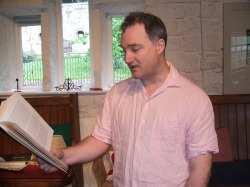
Ian Marchant on writing, being written about and why no one should read his new book...
EVERYONE loves Ian Marchant. And it is true, he’s easy to love. Big-hearted, big-brained, big-boned, personality as big as the Ritz and twice as sparkly.
It is also true that he is infuriating, exasperating, attention-seeking and a general all round show off. He must also be a pain to stand behind at gigs. And hugely frustrating to play against if you are in a rival quiz team.
I know these things – the good things and the bad things – not just because Ian’s a mate but because of the books he writes. Parallel Lines was about the British love affair with railways. And about Ian. The Longest Crawl was about beer. And about Ian. The new one, the brilliant Something of the Night, is about things that happen in Britain in the dark. And about Ian. These books are a mix – what da kidz might call a mash-up – of memoir, travel writing, social history and that new thing we are meant to call psycho geography. They are frank and fearless and illuminating and I’m a fan. If you haven’t read any of his books then read this interview and then hurry to your bookstore to do what you know you must.
Ian, give me your autobiography in exactly 50 words (not 49, not 51)
Conceived in Woking, born in Guildford, schooled in Newhaven, fucked drugged rocked and rolled in Lampeter, died in Brighton, born again in Radnorshire, educated in Lancaster, sold antiquarian books in London, first-aid trained in Devon, returned triumphant to Radnorshire, teach writing at Birmingham City University, sometimes make radio in Bristol.
Why should we read Something of the Night?
Hell, you shouldn’t read it, at least not yet. Reading is ruinous for books; it breaks the spine, and lets in dust and moisture. You should buy it in hardback, and keep it on your most treasured shelf. Postpone reading it until the paperback comes out. Or, if you really must read it now, why not download it onto your Kindle, so that your hardback can stay in mint condition?
You started as a novelist, why the switch to non-fiction?
I once met Bob Marley outside a pub in Brighton, and showed him the way to the Concorde Club. Nice guy. Here in Presteigne, (pop. 2000) I have a friend who was the first person to supply R.D, Laing with LSD, a friend who was jailed in the US for laundering money for an aristocratic all-girl coke smuggling syndicate, and a friend who watched the Velvet Underground in Warhol’s factory while bouncing up and down on a trampoline. Stuff like that couldn’t happen in fiction, because you wouldn’t believe it. Non-fiction just seems to have more scope, I guess.
Also, nobody bought my novels. ‘The Battle for Dole Acre’ is second only to ‘Juggling for A Degree; Mature Students in Further Education’ (edited, with Hilary Arksey) in the list of my hard to find items.
What responsibilities do you feel to the real people who appear in your books?
Loads. I try to give them the best jokes. I change names, dates, places. I’ve only ever had one complaint, and that was from the barman of The Isle of Jura Hotel, who was so falling over drunk on duty that he called the customers and the landlord ‘cunts’. He asked me to take his photo out of the reprint of the paperback edition of ‘The Longest Crawl’. This offers exciting possibilities for collectors, as the paperback therefore exists in two states.
You've had the odd - I assume it's odd - experience of being the subject (at least in part) of a book published last year. What impact did that have on you?
It was a bit odd, yes, and not in a nice way. But there. The author let me read her manuscript. I thought it would be unethical of me to demand changes to the text. The author feels it was unethical of me not to. No dates or places were changed, and I certainly didn’t get the best jokes. No names were changed, but one was omitted, although Camilla Long saw to that in her notorious review. In fact, it was the little storm of press coverage that was the worst bit for my family.
I have asked for acknowledgement for the use of my comic verse in the paperback edition. Completists might want to hang on till it hits the remainder shops.
Your chapter (sort of) in response is brutally, painfully, candid (and also very funny) how hard was that to write?
It was a decision I took quite early on in the writing process. I knew I was going to write about sex, and I knew I wanted to write about transgressive sex. I thought about going dogging, and talking to some working girls, but this seemed to me bogus travel-writing shades into edgy psycho-geography 101, so I decided it would be more honest to write about my own impotent attempts to visit sex workers during my celibate years. My publishers made me change a few bits; in particular, they asked me to write of Jesus’s penis and testicles rather than his cock and balls. The unexpurgated manuscript has been left to Lancaster University in my will, and scholars will flock to see it in the years ahead.
Where do you see yourself in five years time?
Blimey. Writing books, I hope, living here in Presteigne with my wife and family. Doing music sometimes. Making radio programmes. Controlling the second-hand market in ‘The Battle For Dole Acre.’
What's the next book about?
It’s a kind of history of the British counter-culture between 1956 and 1994, written for my students, in order to explain a lost culture whose last echoes they might catch in their Mum’s record collection. It’s also an openly post-Alex Masters biography of a friend of mine called Bob Rowberry who ended up being pretty much everywhere the counter-culture was going off. Procul Harum were named after his cat. The working title is ‘A Hero for High Times’, and is due for publication by Jonathan Cape in late 2013. Cape have a fine tradition of publishing counter-culture stuff; they published Richard Neville’s ‘Play Power’ in 1970 – I have a nice first, with dustwrapper, though sadly it lacks the game insert in the pocket attached to the rear endpaper.
Who - in life or writing - do you most admire and why?
In life, and I’m very much afraid this might make your readers boak their rings, I most admire my wife, a book-woman to her core, who looks like Charlotte Gainsbourg, who puts up with a lot with a whole lot of love, and who is hugely fucking clever and funny.
Her or Gus Poyet.
In writing…. Oh god. I’d take Henry David Thoreau to a desert island. And Orwell’s essays. And The Four Quartets. My favourite book of last year was Richard Beard’s ‘Lazarus is Dead.’, by a country mile. I treat Geert Mak’s ‘In Europe’ much as Network Rail used to treat the Forth Rail Bridge, in that I pretty much start it again as soon as I’ve finished it. It was first published in hardback as ‘In Europa.’ I don’t have the hardback, which makes me sad. I have hinted till I’m blue in the face, but nothing. I am 54 on March 14th.
Tell me something I don't know.
E-books will eventually be a good thing for the secondhand market, as fewer books will be reprinted, thus forcing prices upwards.
Something of the Night is out now in precious hardbook form with Simon and Schuster. The price – though it might seem extortionate now – will look very reasonable in fifty years time…
Friday, 10 February 2012
Lizzie Enfield on being surrounded by psychopaths while loving the mundane
LIZZIE Enfield: wise, kind, thoughtful, funny, quick, bright, shy, reckless too sometimes (in a careful and considered kinda way). She always knows more than she lets on. And worries more than she should. When I met Liz I think I was still slightly thinking of myself as a kind of Bono figure who had, by some terrible cosmic accident been suckered into working as a suburban schoolteacher, while Bono - who let's face it - is an earnest Geography teacher type if ever we saw one - somehow stole my existence pontificating about Big Causes on a Big Stage fronting a band making Big Music. Lizzie saw the real me.
Lizzie christened me Baldrick.
But I didn't take offence. It would have been hard to because she's wise, kind, thoughtful, funny etc etc. And so are her books. What You Don't Know (Headline) came out last year and now is the turn of Uncoupled (Headline) and I guess Lizzie is doing what publishers call 'building a brand' and what her fellow writers might call a mapping out a distinctive territory, and what readers might call writing a series of decent novels which entertain while asking hard questions in a soft voice.
And we're teaching together for the Arvon Foundation in July which should be a laugh. She can be good cop (wise, kind, thoughtful, funny etc etc etc) and I can get to play bad cop which I rarely do (mean, shouty, cruel). I'm looking forward to it.
Oh - and she's Harry's sister but she won't let anyone mention that...
So, Liz. Your autobiography in exactly 50 words (not 49, not 51)
Born in Sussex. Still there! Billingshurst to Brighton via, Norwich and London. Wanted to be a spy but not very good at keeping secrets. Became journalist instead. Divulged stuff for BBC radio, then as a freelance for papers and mags. Still do that, alongside writing. Two novels so far…
What are you doing right now?
Answering your questions, Steve…
And what are you doing next?
Going to meet a friend for coffee – so far so productive - isn’t that what all writers do all day? Why should we read Uncoupled?
You don’t have to! I know you don’t like the swirly/girly cover (which is changing for the paperback because the content is not so swirly/wirly). It’s about a woman who survives a serious train crash and the indefinable relationship that develops after between her and another commuter, with repercussions. A friend just finished reading and said she could not stop laughing – yet, it’s a study of the psychological impact of being involved in major trauma, so I don’t know what she was laughing at.
How different is it to What You Don't Know?
I did a reading the other day and the person who introduced me described Uncoupled as modern Brief Encounter, which is exactly how I described WYDK – so either exactly the same or he had not done his research very well! It’s a similar set up. Everyday family thrown into crisis by outside event/outsider but it’s a bit darker and I hope a bit better.
What's the next book going to be about?
A modern Brief Encounter? The one I’m working on is v different. It’s about a group of once right-on p.c. friends who are now in their forties and have all made compromises. One of them makes a decision she thinks is the right one for her family but it devastates another family in the process… I’m not giving away the main thing, in case a faster writer writes it faster…
Where do you see yourself in five years time?
Writing modern Brief Encounters? Living it up in my second home? Really? Plugging away at another novel, writing freelance stuff, fretting about being fifty, wondering why we will never be able to retire and the children have not left home… The future is mundane but I’m happy with mundane…
You live in Brighton. How true is it that every middle class person in Brighton writes books (or wants to) ?
I think you have your figures slightly wrong, Steve. It’s two in five. Writer, writer, psychotherapist, psychologist, psychopath is the correct current make up of Brighton professions…
Who - in life or writing - do you most admire and why?
Too many writers to mention (and have trouble separating admiration from envy) so will go for life and my admiration goes to handful of close friends who are incredibly giving and good humoured even when their lives are bloody difficult…
Tell me something I don't know...
I was a very, very, shy, quiet, unconfident child/young adult. Now I try to pretend that I am not any of those things. I think I get away with it but underneath all the front, it’s still there. The real me would not be talking to you…
What You Don't Know and Uncoupled are both out now (Headline)
Mine and Lizzie's Arvon course is at the John Osborne Arvon Centre at The Hurst, Shropshire July 9 - July 14 2012
Labels:
Brighton,
Harry Enfield,
Lizzie Enfield,
novels,
psychopaths,
shyness.
Saturday, 4 February 2012
IT'S NOT ABOUT THE BOOKS! - A short note on libraries.
TODAY is National Libraries Day and there will be a lot of chat, a lot of noise about them. I love libraries. How could I not? My dad was a librarian. I spent much of my childhood hanging about in Bedford's County Hall library reading Jane's Fighting Ships and drinking the surprisingly marvellous hot chocolate you could get in the vending machine there. My dad helped design the colour scheme for the new Bedfordshire mobile library service in 1974 (Orange and grey. Dad what were you thinking? You should have asked mum. No, maybe not. Would have inevitably led to a row. God knows everything else did.)
For me, like loads of other people my age and older, libraries sparked off a lifelong reading habit that pretty much defines who we are. Libraries really did set us free.*
Despite that the current debate around libraries is not about the precious books. I don't fetishise books. (you should see how I treat them. Like a dog treats a bone. Not too much reverence there.) It's about the public space. Libraries are the commons of the indoor world. No one owns them. No one can kick you out of them, charge you rent for them, or sell them to you. They can ask you to keep your voice down and that's about it.
The professional classes have largely abandoned libraries. They get their books from Amazon or Waterstones, and they do their computing in Starbucks with a large coffee and a slice of something naughty but nice. A slab of something chocolaty. The professionals - the ABC1s - they can afford to pay the cappucino tax. And councillors and council officials are generally emphatically of the professional classes. And this is why they don't know that libraries are full. Full of ordinary working people thinking, reading, writing CVs, looking for work, getting advice, getting the news, studying or - sometimes - just keeping warm.
They're full of kids too. Because libraries are not just the last public space where someone won't try and make you buy a blueberry muffin to justify your seat - they are pretty much the last places where kids can wander without being run down by a car or happy-slapped by their peers.
People wanting to close libraries love it when the debate is about books. So don't do it, Mr library Campaigner! It's a trap! Make the debate about books and the bean counter will adjust his trendy European style specs and intone statistics about book lending dropping 6.9% year on year, and tell you that current forecasts suggest that the last library book will be issued on September 19 2021 and will be by Catherine Cookson or Jacqueline Wilson.
Don't make books your battleground. I work for the Arts Council and we have a thing we say - we say we want to Achieve Great Art for Everyone and libraries are key to this. Because libraries are where Everyone is. All those places where theatres aren't, galleries aren't, art centres aren't - libraries are. All those people who don't have wireless internet at home, who don't speak English at home, who don't have jobs - they're in the library. Those hard to reach Cs, Ds, Es - the Neets and the Neds. They're all in the library. It's a paradox isn't it? One of the things about Britain I like.
No, it's not about the books - it's about the PC's and a place to meet and talk and plan. If every time someone logged on to a PC it counted the same as a book being issued the bean counting man with the European style specs would have to revise his figures upwards. He would have to agree that libraries were growing more important not less.
And then, just sometimes, it IS about the books. Everyone's first interaction with the arts comes with a visit to the library as a dot, pushed there by proud parents. Every parent does this. Teenage parents do it, just as Islington yummy mummies do it. Even parents who can't read themselves do it. Every new parent wants the best for their kid and every new parent knows this means stimulation and exercising baby's mind as well as as body - and this means books. Kindles don't really cut the mustard when it comes to picture books and anyway who is going to let Millie, Molly, Polly, Olly, Apple or Harper Seven get their rusky fingers all over their new eThing? The germ that will become the next Alesha Dixon, the next Dappy or the next Chris Martin will be nurtured in the childrens section of the library just as the next Zadie Smith will be.
And let's not be fobbed off with 'iconic' mega-libraries either. (isn't 'iconic' becoming a euphemisim for 'disastrous'? - the Millenium Dome was 'iconic' the Scottish Parliament was 'iconic' the bleeding Titanic was 'iconic' in its day) Of course city centres should have their big libraries. Big libraries with hundreds of PCs, lots of meeting rooms, and all the archives and records for everyone researching their family history. And yes, they should probably have quite a few books as well.
But the estates need their libraries, the villages need their libraries. Britain is not just a country of major cities. It is actually a country of small and medium sized towns and semi urban estates - that's where the real action of the UK takes place. That's where people are living and loving, fighting and fucking. And where people live, love, love, fight and fuck. Well, that's where they need their library -their free space. Their place where they won't have to buy a blueberry muffin just to keep out of the drizzle.
*A note on the Manic Street Preachers, the band who put a love of libraries in the top ten of the hit parade (A Design for Life) - I hate them. they were boring before Richey left and only improved slightly after he disappeared. (and I saw them live during the Richey phase. Dreadful racket) If You Tolerate This is quite a good song but for the rest - Jesus, they are Coldplay but with a copy of Das Kapital where the tunes should be. They were right about libraries though.
Wednesday, 25 January 2012
Shelley Harris - On life, writing and why she'd rather be an Ugly Sister than a Dame.
BRITAIN is not a grown up country. We still live with our parents. Sometimes we sulk in our bedroom while hoping that mum and dad will still let us use the car. Even though, actually, it is our car, our house, our everything. We buy the food, pay for the holidays, every goddam thing . Somehow our parents have tricked us into thinking that they are still the boss of us even though they haven't worked for years, weren't really around while we were growing up and are busy spending our inheritance on yachts, helicopters, high grade class A drugs and parties for their sleazy mates.
Britain will never be a grown up country while we have Kings and Queens. I'm sure the individuals royals are mostly very nice and I agree that the version of Celebrity Big Brother they star in isn't quite as tacky as the Ch 5 version. On the other hand it's been going longer and costs a whole lot more. But in fact I feel a bit sorry for the royal family. So let's set them free. let's give them the vote and the right to call themselves Mr and Mrs Windsor. Let's let them grow up and then maybe we can all grow up too.
There's a big royal jamboree coming up this summer but I bet it won't have the impact of the one we all remember: The Silver Jubilee. I was at school. I got a mug. We were all crocodiled out of Park Wood Middle School to see her progress up Brickhill Drive in the royal range rover. We waved plastic flags. Curlew Crescent didn't have a street party but lots of other streets did. They partied like it was VE day or like it was 1895 and Good Queen Vicky was on the throne.
This is the background of Shelley Harris' book Jubilee which has just come out and which the critics are raving about (The Guardian said that they loved this book and were already impatient for the next one). It's a lovely book, and she's a lovely, warm, thoughtful and witty writer. And she's also - not quite - British. Which means she has a shot at being more grown up than the rest of us.
Anyway I asked her some impertinent questions and she replied...
Shelley, Give me your autobiography in exactly 50 words (not 51, not 49...)
Born in Cape Town to a British father and South African mother, emigrated because of their opposition to Apartheid and grew up in Buckinghamshire. Read rampantly, did a series of more (journalist, teacher) or less (envelope-stuffer, mystery shopper) writing-related jobs. Lived in Paris, hatched a couple of kids, wrote Jubilee.
Why should I read Jubilee?
Jubilee is about an iconic photograph of a Silver Jubilee street party in 1977. At the centre of the image is Satish Patel: newcomer, outsider, keeper of secrets. When a reunion is planned, those secrets threaten to emerge, throwing Satish’s life off-course. So you might read it because there are mysteries at its heart, revealed as the book delves deeper into the events of Jubilee day.
Or you might read it because it’s steeped in memories of that time. There tend to be a lot of clichés about the seventies (Abba / flares), but I was interested in the complexities of the decade, the contradictions it contained. The National Front was on the rise, but Britishness was being redefined by a remarkable cohort of immigrants from Idi Amin’s Uganda; Rod Stewart was officially no. 1 on Jubilee day but in all probability, God Save The Queen sold more; Union Jacks were everywhere, but we’d never tug our forelocks in quite the same way again.
How autobiographical is it?
In terms of its location, there’s a strong autobiographical element; Jubilee is set in the village I came to when we settled in Britain. The party takes place in my childhood street, and Satish lives in my family home. So the memories of growing up in that place and time – and of being an outsider there – are my own. But I really wanted the resemblance to finish there: Satish has a different gender, a different ethnicity, and is emotionally repressed in a way I can only aspire to.
Also - let’s be honest about this - Satish is just more interesting than me. I wanted to explore how we become British, a process which was uneven in my case, but would have been much more dramatic for him. Diversity is in our DNA, yet the Silver Jubilee presented nationhood in the most homogenous terms. I wondered: what if you were Asian and newly-British in 1977, at the conjunction of nationalistic fervour and assumptive racism? What would it be like to put on a Union Jack hat and celebrate that very selective version of what it means to be British?
How do you think the coming diamond jubilee will compare with the silver jubilee?
I always think of Andrew Collins, in Where Did It All Go Right: ‘It’s difficult to convey to people how royal the nation was in 1977…As I write this it is the Queen’s Golden Jubilee year and I feel I am in good company not giving a fuck.’ As of 2002, he was spot-on, and I still don’t think we’ll ever return to those days of unquestioning fealty. Having said that, the public response to William & Kate’s wedding last year took me by surprise. I never thought I’d be predicting this, but I think there’s a new upsurge of interest in the Royal Family.
Just writing that makes me feel depressed. I fear that it is, however, true.
Would you accept an honour from the Queen - an OBE or an MBE?
Well I’m no monarchist (and not much of an Empire-builder, either) so that might be a little tricky for me. A friend of mine told me about being in one of Buckingham Palace’s smaller kitchens, and seeing the tea sets the Queen uses – a different one for each day of the week, apparently. So I might ask her if we could just have a cuppa and a chat instead.
Would you become a Dame?
Only if they let me be an Ugly Sister.
What are you working on now?
I’m writing my second novel, which will also be with Weidenfeld and Nicolson. It concerns a very ordinary woman who has a midlife crisis, and does something absolutely extraordinary in response to it.
Who - in life or in writing - do you admire and why?
I’ll do writing please, Steve. Sarah Waters because she is always utterly gripping, and her prose is fabulous; I will buy her on publication day, every single time. Then there’s Jane Harris, because she’s made me jealous with each of her books: The Observations is a masterclass in how to convey a character’s voice, and Gillespie and I builds with this incredible delicate subtlety – such restraint! I’d also have to mention Jon McGregor, whose If Nobody Speaks of Remarkable Things is the book I’d most like to have written.
And finally, Michael Chabon because I think he’s a bona fide genius – so good I’m not even jealous of him. (I rave in detail about him here, if you’re interested:
http://www.independent.co.uk/arts-entertainment/books/reviews/book-of-a-lifetime-the-amazing-adventures-of-kavalier-and-clay-by-michael-chabon-6280566.html).
Hopes for the future?
Other than the health and happiness of my loved ones, what I’d most like is a long-term career in writing. I’d like to be able to develop my craft beyond the second novel, and get better and better – as good as I can possibly be.
Recommend something...
With pleasure. As well as the cracking writers listed above, the one volume I’d like to put into everyone’s hand is the collected prose of Woody Allen. People obviously know his films, and some may have heard recordings of his stand-up (‘I shot a moose, upstate New York…’). But his prose is brilliant, and has seen me through many a long, dark night of the soul. Here, you can find his parody of Yeats (‘Civilization is shaped like a / Circle and repeats itself, while / O’ Leary’s head is shaped like / A trapezoid’), and read the memoirs of Hitler’s barber (‘After the Allied invasion, Hitler developed dry, unruly hair’).
Tell me something I don't know...
I know all the words to all the very worst songs of the eighties – and I’m no slouch at the seventies, either. I know the full libretto of Tell Me On A Sunday, and recently delivered a flawless Where Do You Go To, My Lovely? a full twenty years after last hearing it.
Jubilee is published by Weidenfield and Nicholson and out now...
Sunday, 22 January 2012
The Iron Lady and My Part In Her Downfall
Protest and survive
Looks ugly doesn't it? It wasn't. It was damn good fun and jolly good exercise. All that running. All that shouting. All that righteous fury. The glow I got from Ready Brek as a 1970s primary school kid, I got from protesting in the 1980s (and also from bargain booze and amphetamine to be honest).
I wasn't a very good political activist. Though I tried.
Back then I went to demos the way other people went to the shops. I always nipping out for a rally or popping into town for a picket or a protest. It was the era of miner's strike and there was always something on. The odd thing was that I once I got there I never felt entirely comfortable. I'm too much of a natural doubter - Don't get me wrong I hated the Tories as much as anyone - I was, in the words of the old chant - a Tory hater, but I wanted to win in a Corinthian stylee. Not so much Organise. Agitate. Kick The Tories Out as Organise. Agitate. Beat them Fair and Square in A Public Debate. In some shameful, unacknowledged part of my psyche Maggie! Maggie! Maggie! OUT! OUT! OUT! became Maggie! Maggie! Maggie! Next time we'll persuade more voters to put their crosses in our boxes than in yours! Then you'll be sorry!
I was particularly uncomfortable with No Platform rallies. Remember them? I think (and thought then - though I kept quiet about it) that everyone should have a platform. The point of being on the left is that we are fighting so that everyone can speak. So that everyone gets a voice. One of the big things we are fighting for is the right of our opponents to argue against us. Even if they win. 'I hate what you say - but I defend to the death your right to say it'. That's me - though then I was sort of ashamed of it. (God knows there were plenty of things I should have been ashamed of doing, saying, thinking - but that wasn't one of them... That's always been a thing with me. Feeling shame. And for the wrong things...)
Luckily the behaviour of the police at these things was usually enough to cure the inconvenient doubts. Because the police were reliably horrible. They never seemed to suffer from shame or angst about their part in the rituals of demonstrations. They knew who buttered their bread and it wasn't us.
Just one example: It is 1985 an anti-apartheid demo heading up to Trafalgar Square. Me and my mate Dave have sprinted to the front of the march so that we can nip into The Spice of Life and have a couple of beers while waiting for the Essex Uni contingent to catch up. A couple of beers means a trip to the toilet and have you ever used a public toilet when there are thousands of people milling about trying to topple a government? It can take a while.
Afterwards I'm trying to find Dave and the Essex SU crowd when I discover I'm at the front of the march where a little group of Class War nutjobs are taunting the police. They are chanting 'Tottenham! Tottenham!' not because of any love for the boys from White Hart Lane, but to remind the coppers of the murder in that district of PC Blakelock a couple of years previously. I'm not an idiot. I'm at University. And my uni educated mind tells me that this is all unnecessary and, probably, unwise. That the police are likely to be unhappy about this and unhappy too about the banners that are now being used as missiles - so I turn away. None of my mates will be here that's for sure. And it's then the police charge, lashing out with their truncheons as they come.
Ah, truncheon. Such a nostalgic word. Truncheons have gone the way of typewriters and record players. They seem now like messages from a more innocent time. In the era of the US-style baton they seem benign somehow. Quaint. Almost sweet. Dickensian. The sort of thing a fat Beadle would carry. But they bloody hurt as does the fact that my arm was being bent up behind my back at an impossible angle.
'You'll do.' says the PC. Really. 'You'll do.' I'm scared and in pain but I'm also infuriated and, more than this, I'm curious as to what I'll be charged with. It turns out to be 'obstructing a police officer in the course of his duty.' According to the PC he had been attempting to arrest some chanter, some banner-thrower, when I intervened punching and kicking and swearing and he lists the words I'm meant to have used. I almost blush. To hear such words coming out of the mouth of a uniformed public servant... I can't think it's what Sir Robert Peel had in mind when he founded the force. I'm genuinely shocked. Not just at the words, but how brazen this all is. And then I spend several hours in a cell with a nervous wreck of a guy who has just been told he was going to be charged with attempted murder. A cop has been hit with a full can of Guinness and this chap has been discovered on the demo with a can of Guinness in his hand. He is, the police told him, therefore the obvious perp. He is going down.
The hours pass and eventually I am kicked out of the door to be greeted by a little knot of hyped up activists asking if I need anything. Food? Drink? Train fare? and actually yes, I discover I need all those things. The student union bus has gone you see and I need to get back to Colchester... A girl turns and addresses her fellow campaigners with a (frankly unnecessary) megaphone. 'Comrades! There's a bloke here who needs to get back to Manchester...' No no no Colchester, I whisper but it was too late she is too swept up in her role as Joan of Arc to listen. '...Manchester. Please give whatever you can.' It's like I was a famine and she is a Blue Peter appeal. It's like a little Live Aid. And I have to say, the crowd dig deep. I get more money than I've held in my hand since I started at Uni. And my protests about the wrong town are waved away. No one is listening to me.
I went to court a couple of months later. There were dozens of us and were all absolutely discharged in batches of ten by an exasperated magistrate.
The last big demo I was on was the Poll Tax demo. The infamous riots. I was working by then. Clerking and assistanting for the Probation Service, and it had been our union conference the day before so I was hungover and hadn't had much sleep. Those probation officers can really put it away.
I was going to the demo with my mate Jessica (who later became the BBC producer on the Food Programme...). Jess was much more radical than me. She was in the SWP (who never allowed self-doubt- that was for the Labour Party and other class traitors...) She was also American, fearless and in possession of a camera. When it all kicked off (and my memory is that it all began with a solitary orange juice bottle chucked at the window of a pizza hut) Jessica's instinct was to run towards the police, the horses, the burning cars. It was bonkers but it cured my hangover and the photos were sort of worth it. And it worked of course.
That's the thing with riots - they are an English tradition. And they work. A riot torn street in a deprived neighbourhood today is a City Farm tomorrow. Riots have always been part of the discourse between the ruling class and a disenfranchised working class. And the managers of capitalism do listen. Yes, at the time they're all birch 'em, flog 'em hang em high but then afterwards you'll find quiet concessions, subtle alterations in the course of the ship of state. You'll find, for example, the rhetoric about necessary cuts softened and a plan b gradually introduced(if not named) consisting of some large scale infrastructure projects. And after the poll tax riots Thatcher was gone in weeks. That's all it took. Ding dong the witch was dead. The Iron Lady turned out not to be so very tough after all.
The next time I was on a really big demo was the huge anti-war thing in 2003. A million of us marching through the city and lots of people like me who hadn't been on a demo in years. I think we were all a bit over excited. Not only was it a huge, huge demo which they couldn't ignore. (Couldn't they? Of course they could... it would have different had it turned nasty. If they'd had to use the water cannon and the rubber bullets.) There was hope and happiness in the air. It was like a massive reunion. Veterans of all those old battles back together for one last gig. And what a gig. A million of us. A million. But times had changed a bit. There were a lot of people breaking off from the demo saying 'ooh there's a great little vintage shop down here...' or ' there's this amazing organic bakery round here somewhere.' I suspect a lot of the marchers had olives and hummus in those sandwiches. I know I did.
And now there's a new generation of student activists - smarter than we were I think. Witness how clumsy they make the police look. One goateed geek with an iPhone seems worth entire squadrons of police transits when it comes to organising the movements of large groups of people. 'I see your kettle and I raise it...' and it's because they're smarter that the authorities come down harder.
And I think the current generation of activists are angrier too. They bloody well should be. I do still prefer rational debate - and these days I'm not ashamed of doubt. It's people who have no doubts that worry me. But these days more than ever I think students should be out of the streets Occupying, Defending. Trying to make people listen. And you can tell that they've already got the ruling class rattled. Four years hard time for writing 'let's have a riot' on Facebook? A year in chokey for climbing on a statue of Winston Churchill? These are not the responses of politicians who feel confident and in control.
In ten or twenty years time some of the things that are happening now will look ridiculous. Some actions might look embarrassing. Some - most - of today's student activists will have stories of generalised daftness But so what? Plenty of things worse than embarrassment. Doing nothing, saying nothing. Letting the bastards grind you down. That's all much worse. Isn't it?
Looks ugly doesn't it? It wasn't. It was damn good fun and jolly good exercise. All that running. All that shouting. All that righteous fury. The glow I got from Ready Brek as a 1970s primary school kid, I got from protesting in the 1980s (and also from bargain booze and amphetamine to be honest).
I wasn't a very good political activist. Though I tried.
Back then I went to demos the way other people went to the shops. I always nipping out for a rally or popping into town for a picket or a protest. It was the era of miner's strike and there was always something on. The odd thing was that I once I got there I never felt entirely comfortable. I'm too much of a natural doubter - Don't get me wrong I hated the Tories as much as anyone - I was, in the words of the old chant - a Tory hater, but I wanted to win in a Corinthian stylee. Not so much Organise. Agitate. Kick The Tories Out as Organise. Agitate. Beat them Fair and Square in A Public Debate. In some shameful, unacknowledged part of my psyche Maggie! Maggie! Maggie! OUT! OUT! OUT! became Maggie! Maggie! Maggie! Next time we'll persuade more voters to put their crosses in our boxes than in yours! Then you'll be sorry!
I was particularly uncomfortable with No Platform rallies. Remember them? I think (and thought then - though I kept quiet about it) that everyone should have a platform. The point of being on the left is that we are fighting so that everyone can speak. So that everyone gets a voice. One of the big things we are fighting for is the right of our opponents to argue against us. Even if they win. 'I hate what you say - but I defend to the death your right to say it'. That's me - though then I was sort of ashamed of it. (God knows there were plenty of things I should have been ashamed of doing, saying, thinking - but that wasn't one of them... That's always been a thing with me. Feeling shame. And for the wrong things...)
Luckily the behaviour of the police at these things was usually enough to cure the inconvenient doubts. Because the police were reliably horrible. They never seemed to suffer from shame or angst about their part in the rituals of demonstrations. They knew who buttered their bread and it wasn't us.
Just one example: It is 1985 an anti-apartheid demo heading up to Trafalgar Square. Me and my mate Dave have sprinted to the front of the march so that we can nip into The Spice of Life and have a couple of beers while waiting for the Essex Uni contingent to catch up. A couple of beers means a trip to the toilet and have you ever used a public toilet when there are thousands of people milling about trying to topple a government? It can take a while.
Afterwards I'm trying to find Dave and the Essex SU crowd when I discover I'm at the front of the march where a little group of Class War nutjobs are taunting the police. They are chanting 'Tottenham! Tottenham!' not because of any love for the boys from White Hart Lane, but to remind the coppers of the murder in that district of PC Blakelock a couple of years previously. I'm not an idiot. I'm at University. And my uni educated mind tells me that this is all unnecessary and, probably, unwise. That the police are likely to be unhappy about this and unhappy too about the banners that are now being used as missiles - so I turn away. None of my mates will be here that's for sure. And it's then the police charge, lashing out with their truncheons as they come.
Ah, truncheon. Such a nostalgic word. Truncheons have gone the way of typewriters and record players. They seem now like messages from a more innocent time. In the era of the US-style baton they seem benign somehow. Quaint. Almost sweet. Dickensian. The sort of thing a fat Beadle would carry. But they bloody hurt as does the fact that my arm was being bent up behind my back at an impossible angle.
'You'll do.' says the PC. Really. 'You'll do.' I'm scared and in pain but I'm also infuriated and, more than this, I'm curious as to what I'll be charged with. It turns out to be 'obstructing a police officer in the course of his duty.' According to the PC he had been attempting to arrest some chanter, some banner-thrower, when I intervened punching and kicking and swearing and he lists the words I'm meant to have used. I almost blush. To hear such words coming out of the mouth of a uniformed public servant... I can't think it's what Sir Robert Peel had in mind when he founded the force. I'm genuinely shocked. Not just at the words, but how brazen this all is. And then I spend several hours in a cell with a nervous wreck of a guy who has just been told he was going to be charged with attempted murder. A cop has been hit with a full can of Guinness and this chap has been discovered on the demo with a can of Guinness in his hand. He is, the police told him, therefore the obvious perp. He is going down.
The hours pass and eventually I am kicked out of the door to be greeted by a little knot of hyped up activists asking if I need anything. Food? Drink? Train fare? and actually yes, I discover I need all those things. The student union bus has gone you see and I need to get back to Colchester... A girl turns and addresses her fellow campaigners with a (frankly unnecessary) megaphone. 'Comrades! There's a bloke here who needs to get back to Manchester...' No no no Colchester, I whisper but it was too late she is too swept up in her role as Joan of Arc to listen. '...Manchester. Please give whatever you can.' It's like I was a famine and she is a Blue Peter appeal. It's like a little Live Aid. And I have to say, the crowd dig deep. I get more money than I've held in my hand since I started at Uni. And my protests about the wrong town are waved away. No one is listening to me.
I went to court a couple of months later. There were dozens of us and were all absolutely discharged in batches of ten by an exasperated magistrate.
The last big demo I was on was the Poll Tax demo. The infamous riots. I was working by then. Clerking and assistanting for the Probation Service, and it had been our union conference the day before so I was hungover and hadn't had much sleep. Those probation officers can really put it away.
I was going to the demo with my mate Jessica (who later became the BBC producer on the Food Programme...). Jess was much more radical than me. She was in the SWP (who never allowed self-doubt- that was for the Labour Party and other class traitors...) She was also American, fearless and in possession of a camera. When it all kicked off (and my memory is that it all began with a solitary orange juice bottle chucked at the window of a pizza hut) Jessica's instinct was to run towards the police, the horses, the burning cars. It was bonkers but it cured my hangover and the photos were sort of worth it. And it worked of course.
That's the thing with riots - they are an English tradition. And they work. A riot torn street in a deprived neighbourhood today is a City Farm tomorrow. Riots have always been part of the discourse between the ruling class and a disenfranchised working class. And the managers of capitalism do listen. Yes, at the time they're all birch 'em, flog 'em hang em high but then afterwards you'll find quiet concessions, subtle alterations in the course of the ship of state. You'll find, for example, the rhetoric about necessary cuts softened and a plan b gradually introduced(if not named) consisting of some large scale infrastructure projects. And after the poll tax riots Thatcher was gone in weeks. That's all it took. Ding dong the witch was dead. The Iron Lady turned out not to be so very tough after all.
The next time I was on a really big demo was the huge anti-war thing in 2003. A million of us marching through the city and lots of people like me who hadn't been on a demo in years. I think we were all a bit over excited. Not only was it a huge, huge demo which they couldn't ignore. (Couldn't they? Of course they could... it would have different had it turned nasty. If they'd had to use the water cannon and the rubber bullets.) There was hope and happiness in the air. It was like a massive reunion. Veterans of all those old battles back together for one last gig. And what a gig. A million of us. A million. But times had changed a bit. There were a lot of people breaking off from the demo saying 'ooh there's a great little vintage shop down here...' or ' there's this amazing organic bakery round here somewhere.' I suspect a lot of the marchers had olives and hummus in those sandwiches. I know I did.
And now there's a new generation of student activists - smarter than we were I think. Witness how clumsy they make the police look. One goateed geek with an iPhone seems worth entire squadrons of police transits when it comes to organising the movements of large groups of people. 'I see your kettle and I raise it...' and it's because they're smarter that the authorities come down harder.
And I think the current generation of activists are angrier too. They bloody well should be. I do still prefer rational debate - and these days I'm not ashamed of doubt. It's people who have no doubts that worry me. But these days more than ever I think students should be out of the streets Occupying, Defending. Trying to make people listen. And you can tell that they've already got the ruling class rattled. Four years hard time for writing 'let's have a riot' on Facebook? A year in chokey for climbing on a statue of Winston Churchill? These are not the responses of politicians who feel confident and in control.
In ten or twenty years time some of the things that are happening now will look ridiculous. Some actions might look embarrassing. Some - most - of today's student activists will have stories of generalised daftness But so what? Plenty of things worse than embarrassment. Doing nothing, saying nothing. Letting the bastards grind you down. That's all much worse. Isn't it?
Friday, 6 January 2012
Anthony Clavane - on football, Leeds, songwriting and when it's ok to hack phones
You all know Anthony Clavane of course - the gifted songwriter, the underground troubadour, the love-child of Leonard Cohen and Nick Drake. Bon Iver's more thoughtful, better read, more politically astute older brother.
Well your loss if you don't. Most people - most readers of this blog - will know Anthony as the author of The Promised Land last year's surprise best-selling, award-winning account of growing up with the burden of being a Leeds Utd fan. hough actually that does both Anthony and the book a disservice because The Promised Land is more than that. More than a Northern Fever Pitch. It's about fooball yes, but it's also about industrial growth and decline and about being an outsider within tribes of outsiders. It's popular social history as well as football memoir.
And some people will know him as a football writer on the Sunday Mirror. But when I first met Anthony he was a history teacher in Colchester and also a songwriter. A brilliant songwriter (I think he was probably an okay history teacher). So brilliant that when I got the chance to write a play (Still Waiting For Everything) I built it around some of those songs. I will still contend that just because his greatest hits remain largely unheard that doesn't make them any less astounding. He's got half a dozen that would stand comparison with any of the canonical singer-songwriter classics. I know it. A handful of his friends and family know it. The 500 people across the country that came to see my - very fringey - play know it. And one day - possibly quite soon - you will know it too.
Oh and he's working on another book too (but then so is everyone I know...)
Can you give me your autobiography in exactly 50 words (not 49, not 51)
Born and brought up in Leeds . History teacher, news reporter, "Independent" feature writer and sportswriter with the "Mirror". Teaches at the Arvon Foundation, wrote the songs for the play "Still Waiting For Everything". First book, "Promised Land", won Sports Book of the Year at the 2011 National Sporting Club Awards.
Why should I read “Promised Land”?
I know it’s based on the fortunes of a football team, Leeds United, but people who don't like football - like Ian McMillan's wife - like it. Apparently. It’s really about cultural outsiders; how people (like me), cities (like Leeds) and tribes (like the Jewish community) have attempted to escape their pasts by reinventing themselves – and the price that has to be paid for these reinventions. It’s a kind of love story really, or at least a love letter to the three things that shaped by early life: Leeds , football and Jewishness. I’m still living with the guilt of turning my back on all three in my 20s.
Did you learn anything during your research that surprised you?
Where do I begin? Houdini failing to escape from a Tetley’s beer barrel, and almost dying from the alcohol fumes because he was teatotal. Cuthbert Brodrick designing Leeds Town Hall in his early 30s - then buggering off to France with a married woman. Alan Bennett excitedly spotting Leeds manager Don Revie outside the Queens Hotel kitchen; The Don was waiting to collect takeaway lunches for his players. Bennett mistaking the artist Jacob Kramer, who had an art gallery named after him, for a tramp when he almost fell over him…outside the art gallery. Albert Johanneson, the first black footballer to play in an FA Cup Final, giving all his medals to my friend’s dad and asking him to put them in his safe because he was worried he’d pawn them (Albert had become an alcoholic). The gypsy Revie had asked to remove the “curse” on Elland Road urinating on all four corners of the pitch (it didn't work). The great northern realist writer David Storey signing a long-term contract with Leeds Rugby League – and using the money to pay for his art course at the Slade School of Art. Pele headbutting Billy Bremner. The young Damien Hirst living near Eric Cantona, though not at the same time…
The Dirty Leeds nickname - that was actually pretty fair wasn't it?
Yes and no. The London media hated these cocky northern upstarts because they were unfashionable, played to win and, yes, cut corners. Many of the cynical things they did were in response to the gamesmanship of the European teams they played in the mid-1960s. What’s really interesting is the club’s repeated attempts to shed this image. First Super Leeds – the “total football” side of the mid-1970s, then Wilko’s wonders – with the late, great Gary Speed, Strachan and Gary McAllister in midfield – and finally O’Leary’s babies. All these attempts failed. How come Arsenal can successfully get away with reinventing themselves under Arsene Wenger and we can't? I’m also interested in this nickname as a “personal myth” – from Dickens and Shaw, who thought industrial Leeds was a beastly place that should be burned down, to Hirst and David Peace. Why are some people, groups, teams nicknamed “dirty”. As Mary Douglas said: “Dirt is matter out of place.”
You've lived away from Yorkshire for quite a while - how have your feeling towards your home city changed over the years?
My mum and dad and lots of Clavanes still live in Leeds so I spend a lot of time in the capital of God's Own Country. Back in the 1970s there were so many prodigal-son-returns-oop-north novels and films. I loved them all, especially “Charlie Bubbles” and “Get Carter” (although Caine was too lazy to use a northern accent). When I first went back, in the crappy 1980s, it was a kind of hell. In the 1990s things suddenly changed. I’ve never been in Harvey Nicks, but I was a big fan of the new Leeds . I liked its aspirational drive. There’s an incredible energy in Leeds at the moment – but, like most northern cities, it's up against a government run by out-of-touch southern toffs.
What are you working on now?
I’ve been commissioned by Red Ladder Theatre Company to write a play, with Nick Stimson, based on “Promised Land” – to be performed at Leeds Carriageworks in June 2012 – and I’m also working on my new book “Does Your Rabbi Know You’re Here?”, which is about Jewish involvement in English football.
I'm a fan of your songwriting. How come there is such a select band of us that know about this side of your life?
Why thank you. Maybe it’s because my songs aren’t that good, really. But I’m writing the songs for the play and maybe you and my mum will be joined by more admirers.
Where do you see yourself in five years time?
Writing the difficult sixth book – and more songs that nobody, apart from you and my mum, listen to.
Recommend something...
“The Big Lebowski” Okay, everyone knows about that. Anna Karina? She's my favourite actress. Do you mean obscure-ish? My favourite Scottish singer-songwriter is Aidan John Moffat from "Arab Strap".
And finally... tell me something I don't know...
I went to jail in the 1980s for handing out ‘Free Nelson Mandela’ leaflets outside the South African Embassy. Oh yes, and I hate people winking at me.
I'm sorry I have a twitch... and the real final question... the Columbo question: Mr Clavane - you are a tabloid journalist. have you ever hacked a phone? Are there circumstances in which you feel phone-hacking is justified?
I am not now, nor have I ever been, a phone hacker. In the Second World War, definitely justified. Although Hitler never left any voicemails, I think British intelligence was up to some dodgy stuff back then. And quite right too.
Labels:
Aidan Moffat,
Anthony Clavane,
Hitler,
Leeds United,
phone-hacking,
Red Ladder,
songwriting
Saturday, 31 December 2011
For Emma From 27 years ago
I know straightaway it's her. She looks a little tired, a little distracted but so does everyone. It's the afternoon December 23 after all. the last proper shopping day before Christmas and we're feeling the tremours that herald the coming of the retail earthquake that is man-dash. Those hours when 99.7% of all the world's perfumes are sold to drunk men suddenly gripped by fear at the thought of their significant others waking to Not Enough from Santa come The Day. It's also when all the Kate Bush albums get bought. And this year it was the period when four million copies of Caitlin Moran's How To Be a Woman were shifted. (These are facts btw. Authenticated numbers.)
But I'm not writing about the panicky shopping habits of men. I'm writing about the fact that in Leeds last week I walked past Emma Dawson - the girl who broke my heart in the summer of 1984. And then kept breaking my heart for most of 1985. Though that's wrong isn't it? When hearts get broken the fault generally lies with the owners. They are often responsible for having recklessly put those fragile hearts in places where they were bound to get smashed. Or they were criminally negligent in giving them to people who didn't realise what they were - and who would have have refused them if they had known: 'It's your heart you say? Take it back. why the fuck would I want that?'
Anyway, the point is I met Emma in Colchester in the Autumn of 1983, gave her my heart in 1984 and by that summer it was pretty much busted and now - 27 and a half years later - I was in Leeds with my smallest boy - the young Judomaster - getting ready to buy Kate Bush albums, Caitlin Moran books and scent for my wife of twelve years. There she was - tired, distracted but emphatically herself - walking towards me looking pretty much exactly the same as she did back then. She was a good-looking young woman and now she was a good-looking older woman. She'd added a bit of tired gravitas to her white rose teenage looks
So what happened next?
Nothing happened next. We didn't even speak. We passed within three feet of each other. If I was a betting man (and I am actually) I'd give good odds that she saw me and, like me, considered the stop and chat and decided against it. It was raining. We were in a time pressured situation vis-a-vis the buying of Bush/Moran/Scent...
What was great for me was to feel Nothing Much. certainly no pain. Though there was a sudden flush of embarrassment. Embarrasment's ok - we can all live with that. Just as well isn't it? It felt pretty good to feel Nothing Much good enough that after she'd passed I nearly turned around to catch up with her just so I could feel Nothing Much all over again. But that would have been weird.
Because there was a period when I couldn't think of her without filling up (yes I know it's pathetic. But I was a twenty year old Smiths fan. The Go Betweens Spring Hill fair was my favourite album of that year. I was sensitive. I read poetry.)
The thing about Emma Dawson was that she was always out of my league. Palely beautiful with dark hair and an easy laugh... It was enough, more than enough. those are dangerous weapons in the wrong hands.
Thrown together at Essex University (her: Art History of course. Me: English and European Literature also of course) we hung out more or less constantly from Freshers Week. We were mates and I never expected anything else. And actually I had a bit of a crush on Camilla Beswick who played for my five-a-side team the Bash Street Kids (we were the only team in the league to have a girl playing for us so we were sort of always moral victors even when we lost. Which was most of the time. It wasn't Camilla's fault btw - she was pretty good. A regular Gregory's Girl.)
Anyway Emma kept coming round to my room in BR3 - one of the giant towerblocks at Essex. The ones that were meant to be a modernist architectural representation of the hills around Sienna but were more like the outskirts of Stalinist-era Murmansk.
She would stay for hours. She would listen to me go on about - well everything. Music. Books. Politics. Cooking. I hope I didn't give her little lectures on Art History but I wouldn't put it past me. she would listen to my records. She would laugh with me and at me and expertly make the thinnest of rollies. She used the word rebarbative in conversation which would normally be enough to get me hooked but I still didn't consider her as a potential girlfriend. We were mates. Mates.
Then one night she came round and made it very very plain that she had no intention of leaving at all. I say she made it very plain but it took till about four in the morning before I started to get the message. In fact it took until her tongue was in my mouth and one hand on the crotch of my skinny black jeans while the other crept underneath my baggy paisley shirt before I really got the gist. I could be a bit dim in those days. An aute awareness of body language not really being my thing.
And what I wonder did Emma see in me? I looked like an exotic wading bird back then. A kind of anxious scruffy crane or something. So skinny (I was nine stone) I was all shin and knees and pointy hips, pointy elbows and long pointy beak. And lets not forget the pointy hair that was both black and Krazy kolor blonde - the kind of two tone look that would later become surprisingly popular with Northern milfs running amok on hen nights. Quite possibly it was my apparent indifference to her looks.
Anyway by the end of that night we were lovers which meant, of course, that we were no longer mates. This took a few weeks to become really obvious but I went from being an opinionated motormouth, happy to go his own way do his own thing - to only wanting to be where Emma was.And to do whatever it was that she was doing. I agreed with her enthusiastically all the time. About everything - even when she was patently talking bollocks. I worried if she wasn't around. More than that - I was bewitched by fear. Where was she? what was she doing? who was she doing it with? Even if she was in a Art History seminar then I might fret about who she was sitting with about shared jokes with her tutor. I know what those pre-Raphaelites were like. Sex mad the lot of them. And the academics who studied them were even worse...
In short in a matter of days I had become one of the less likeable Nick Hornby characters.
As I say this transformation took a while to manifest itself. I think I probably had the good sense to keep it well hid for a few weeks. And we did have a good time. We played a lot of pool badly. We had a lot of adventurous sex (I was 20 - it was ALL adventurous to me then). We saw some bands. I remember her watch - an 18th birthday present - came off in the mosh-pit at a Sisters of Mercy gig. She was crying and so I plunged amid all the shiny shiny boots of leather to try and find it. A few members of the sisterhood wondered - naturally enough - what the fuck I thought I was doing? Word spread until, in an act of large-scale generosity as surprising as it was gallant, the whole mosh pit was on its knees looking for Emma Dawson's bloody watch. This must have looked very weird from the stage and I've often wondered what Andrew Eldritch, the main Sister, made of it. The watch got found btw and as soon as it was restored to its owner the moshing began again with redoubled fervour as if to make up for the minutes lost to random kindness.
She met my parents. And then the first year was over and she went back North to Tadcaster (she was the first Northern person I'd ever known) and I went to my mum's new flat in Enfield and got a holiday job in the gun factory. (luxury mews apartments now of course - because that's what we do these days. Put shoddy houses where once we used to make things)
It was an interesting place but a boring job and I spent most of day dreaming up witty erudite but mostly very, very long letters. at least one a day, often two, occasionally three. There might have been one day when I sent a letter on the way to work, another at the afternoon break (written at lunch) and another on the way home (written on the bus). I'm guessing I was pretty unhappy. I knew no one in Enfield, the job was hard but badly paid, everyone seemed to know more than I did about everything (even though I was the only one with certificates). They even beat me at frigging scrabble.
I think I might have put her off a bit. What would you think if you got three or four letters a day from someone? thank Christ we didn't have mobile phones then. I'm sure the guy who sends four long love letters a day in 1984 is the same kind of sinister sap who sends half hourly texts these days.
Anyway she invited me up to Tadcaster for A Big Family Party this was a celebration of her sister's 21st, her mum's 50th and her parents 25th wedding anniversary. A bit of a do in other words.
And it was pretty obvious Em had cooled. I was left at home 'making a mix tape' for the party while she went off to York shopping. I was left to play Subbuteo with her 13 year old brother and, at the party itself had to have a million conversations with tweedy Aunts about my incongruous parrots hair (by now I had added royal blue to make a vivid tricolour of my own head. Black, yellow, blue.) Emma was pretty much nowhere to be seen. She - perhaps sensibly -got wasted and had to be put to bed by her mum before nine.
And then finally the next morning I was put out of my misery, given my P45 in a short conversation by a hungover but not in the least tearful Emma - and that should have been that. Unfortunately my pride and my dignity had gone missing along with my heart and I spent the next year trying to get her back. This involved a certain amount of begging and pleading, some crying, quite a bit of following her around - all the time maintaining the desperate fiction that we were still mates. We even made out. A snog and a fumble around christmas that ended with Emma saying 'I bet you thought you were in there...' before calling a cab.
Trying to win Emma back did also somehow seem to involve getting off with her friends. The logic of this escapes me - but the logic of more or less everything I did back then escapes me. The past isn't just a foreign country sometimes it seems like an entire alien planetary system.
And then one day I woke up cured. More or less just like that. One day I was a snivelling wreck who - had it not been for advanced cowardice and a fear of needles - would have had Emma Forever tattooed in Sanskirt across his back. And the next I wasn't really bothered about her. Weird, huh? Or just being twenty? And a year later I was a dad - but that's a whole other story...
Emma did however have another big humiliation to inflict. Or, rather, I had had one more big humiliation to inflict on myself courtesy of her presence.
In 1992 I had just split up with my daughter's mum and was living - still in Colchester - in a terrace with a remarkably tolerant old schoolfriend. And I got a letter inviting me to Emma's wedding in York. She was getting married to a guy who'd been in the year below of us at uni. And I decided to go. And I decided to take my friend Rachel. Now Rachel was vivacious, striking. The kind of dirty blonde that regularly got blokes following her home. I suppose I fancied her a bit but hanging out with Rachel could be tiring what with all the shoals of sharp-faced men swirling around showing their nasty little teeth. And she preferred criminals anyway. We were emphatically platonic and - at the time - proper pals. Chums (later we shared a house and within a couple of weeks weren't speaking but that was all in the future).
R drove me North and the wedding was a lavish affair. I was, oddly, the only one of E's friends from Uni to make it up there and they missed a treat I have to say. Mr Dawson had done his daughter proud. York Moot Hall with a free bar. No - really, really free. You could (and I proved this by empirical research) go up to the bar and ask for a dozen King Edward cigars and get them. You could ask for ludicrous combinations of drinks and get them. 'Sextuple tequila with vintage malt chaser, Sir? - Certainly coming right up?' Anyway everyone got thoroughly horribly trashed - it would have been very rude not to.
Everyone was very complimentary about my foxy girlfriend Rachel and I didn't bother going through the whole 'she's actually not my girlfriend she's just a mate' routine. Too complicated and I was enjoying being a E's wedding with the best looking girl in the room. I was enjoying it right up until the moment Rachel got off with Pete, E's little brother - no longer 13 but 21and by now interested in things other than Subbuteo. No longer all that little either. As far as the party was concerned I was being publically cuckolded by my current girlfriend at my former girlfriend's wedding. Plus I'd already told E - in fun. In FUN Christ can't you guys take a joke - that it 'should have been me. It should have been us getting married.' She nearly pissed herself. Practically choked on her rum and wkd or whatever...
I'd also had a brief conversation in the bogs with her dad where he had had laughed about how fucking ridiculous I'd looked the weekend of the party where Emma had dumped me. How horrified they'd all been when I turned up. He assured me it hadn't just been my hair... which made me feel great as you might imagine.
That was 1992. And it wasn't actually the last time I'd run into her. That had been in 2004 when I'd gone out for dinner in a country gastro pub out in the wilds of west yorks. It was my wife's birthday and we were out wih my in-laws and as we arrived E was in there - yes, getting wasted actually - with some friends. We spoke briefly. She was divorced, two kids 8 and 6, working in business - a finance director for some big company actually (when I knew her she was not only doing Art History - and doing it half-heartedly - but she could barely count her change and managed her finances pretty recklessly as I remember: spending quite a bit on shoes, pale make-up and fancy eyeliner. Sisters of Mercy fan remember...) and she was living in this village all of a mile from my new home. At the urging of one of her friends we swapped mobile numbers.
Later, at the urging of my mother-in-law- I ripped her number up.
And now seven and a bit years on from that last awkward encounter - she was walking towards me in Leeds City Centre at Christmas a time when we reflect on the past and all that it means.
Should we have stopped. Caught up and what has happened since? Laughed together at how that idiot boy in the skinny black jeans and cockatoo hair became the balding gentleman she was now talking to. Talked about the vandalism of time, swapped affectionate stories of our children. Maybe I could have casually mentioned my published novels, my plays, my time working on a Top Television Soap Opera (disastrous but she wouldn't have to know that). Maybe I could have invited her to the launch of my next book (only three months away now - I mention this just in passing you understand...) And she could have told me about... oh whatever is going on in the world of finance directoring...
Perhaps we should have but later the young Judomaster would be bound to ask 'who was that lady Daddy?' and what would I say?
But I'm not writing about the panicky shopping habits of men. I'm writing about the fact that in Leeds last week I walked past Emma Dawson - the girl who broke my heart in the summer of 1984. And then kept breaking my heart for most of 1985. Though that's wrong isn't it? When hearts get broken the fault generally lies with the owners. They are often responsible for having recklessly put those fragile hearts in places where they were bound to get smashed. Or they were criminally negligent in giving them to people who didn't realise what they were - and who would have have refused them if they had known: 'It's your heart you say? Take it back. why the fuck would I want that?'
Anyway, the point is I met Emma in Colchester in the Autumn of 1983, gave her my heart in 1984 and by that summer it was pretty much busted and now - 27 and a half years later - I was in Leeds with my smallest boy - the young Judomaster - getting ready to buy Kate Bush albums, Caitlin Moran books and scent for my wife of twelve years. There she was - tired, distracted but emphatically herself - walking towards me looking pretty much exactly the same as she did back then. She was a good-looking young woman and now she was a good-looking older woman. She'd added a bit of tired gravitas to her white rose teenage looks
So what happened next?
Nothing happened next. We didn't even speak. We passed within three feet of each other. If I was a betting man (and I am actually) I'd give good odds that she saw me and, like me, considered the stop and chat and decided against it. It was raining. We were in a time pressured situation vis-a-vis the buying of Bush/Moran/Scent...
What was great for me was to feel Nothing Much. certainly no pain. Though there was a sudden flush of embarrassment. Embarrasment's ok - we can all live with that. Just as well isn't it? It felt pretty good to feel Nothing Much good enough that after she'd passed I nearly turned around to catch up with her just so I could feel Nothing Much all over again. But that would have been weird.
Because there was a period when I couldn't think of her without filling up (yes I know it's pathetic. But I was a twenty year old Smiths fan. The Go Betweens Spring Hill fair was my favourite album of that year. I was sensitive. I read poetry.)
The thing about Emma Dawson was that she was always out of my league. Palely beautiful with dark hair and an easy laugh... It was enough, more than enough. those are dangerous weapons in the wrong hands.
Thrown together at Essex University (her: Art History of course. Me: English and European Literature also of course) we hung out more or less constantly from Freshers Week. We were mates and I never expected anything else. And actually I had a bit of a crush on Camilla Beswick who played for my five-a-side team the Bash Street Kids (we were the only team in the league to have a girl playing for us so we were sort of always moral victors even when we lost. Which was most of the time. It wasn't Camilla's fault btw - she was pretty good. A regular Gregory's Girl.)
Anyway Emma kept coming round to my room in BR3 - one of the giant towerblocks at Essex. The ones that were meant to be a modernist architectural representation of the hills around Sienna but were more like the outskirts of Stalinist-era Murmansk.
She would stay for hours. She would listen to me go on about - well everything. Music. Books. Politics. Cooking. I hope I didn't give her little lectures on Art History but I wouldn't put it past me. she would listen to my records. She would laugh with me and at me and expertly make the thinnest of rollies. She used the word rebarbative in conversation which would normally be enough to get me hooked but I still didn't consider her as a potential girlfriend. We were mates. Mates.
Then one night she came round and made it very very plain that she had no intention of leaving at all. I say she made it very plain but it took till about four in the morning before I started to get the message. In fact it took until her tongue was in my mouth and one hand on the crotch of my skinny black jeans while the other crept underneath my baggy paisley shirt before I really got the gist. I could be a bit dim in those days. An aute awareness of body language not really being my thing.
And what I wonder did Emma see in me? I looked like an exotic wading bird back then. A kind of anxious scruffy crane or something. So skinny (I was nine stone) I was all shin and knees and pointy hips, pointy elbows and long pointy beak. And lets not forget the pointy hair that was both black and Krazy kolor blonde - the kind of two tone look that would later become surprisingly popular with Northern milfs running amok on hen nights. Quite possibly it was my apparent indifference to her looks.
Anyway by the end of that night we were lovers which meant, of course, that we were no longer mates. This took a few weeks to become really obvious but I went from being an opinionated motormouth, happy to go his own way do his own thing - to only wanting to be where Emma was.And to do whatever it was that she was doing. I agreed with her enthusiastically all the time. About everything - even when she was patently talking bollocks. I worried if she wasn't around. More than that - I was bewitched by fear. Where was she? what was she doing? who was she doing it with? Even if she was in a Art History seminar then I might fret about who she was sitting with about shared jokes with her tutor. I know what those pre-Raphaelites were like. Sex mad the lot of them. And the academics who studied them were even worse...
In short in a matter of days I had become one of the less likeable Nick Hornby characters.
As I say this transformation took a while to manifest itself. I think I probably had the good sense to keep it well hid for a few weeks. And we did have a good time. We played a lot of pool badly. We had a lot of adventurous sex (I was 20 - it was ALL adventurous to me then). We saw some bands. I remember her watch - an 18th birthday present - came off in the mosh-pit at a Sisters of Mercy gig. She was crying and so I plunged amid all the shiny shiny boots of leather to try and find it. A few members of the sisterhood wondered - naturally enough - what the fuck I thought I was doing? Word spread until, in an act of large-scale generosity as surprising as it was gallant, the whole mosh pit was on its knees looking for Emma Dawson's bloody watch. This must have looked very weird from the stage and I've often wondered what Andrew Eldritch, the main Sister, made of it. The watch got found btw and as soon as it was restored to its owner the moshing began again with redoubled fervour as if to make up for the minutes lost to random kindness.
She met my parents. And then the first year was over and she went back North to Tadcaster (she was the first Northern person I'd ever known) and I went to my mum's new flat in Enfield and got a holiday job in the gun factory. (luxury mews apartments now of course - because that's what we do these days. Put shoddy houses where once we used to make things)
It was an interesting place but a boring job and I spent most of day dreaming up witty erudite but mostly very, very long letters. at least one a day, often two, occasionally three. There might have been one day when I sent a letter on the way to work, another at the afternoon break (written at lunch) and another on the way home (written on the bus). I'm guessing I was pretty unhappy. I knew no one in Enfield, the job was hard but badly paid, everyone seemed to know more than I did about everything (even though I was the only one with certificates). They even beat me at frigging scrabble.
I think I might have put her off a bit. What would you think if you got three or four letters a day from someone? thank Christ we didn't have mobile phones then. I'm sure the guy who sends four long love letters a day in 1984 is the same kind of sinister sap who sends half hourly texts these days.
Anyway she invited me up to Tadcaster for A Big Family Party this was a celebration of her sister's 21st, her mum's 50th and her parents 25th wedding anniversary. A bit of a do in other words.
And it was pretty obvious Em had cooled. I was left at home 'making a mix tape' for the party while she went off to York shopping. I was left to play Subbuteo with her 13 year old brother and, at the party itself had to have a million conversations with tweedy Aunts about my incongruous parrots hair (by now I had added royal blue to make a vivid tricolour of my own head. Black, yellow, blue.) Emma was pretty much nowhere to be seen. She - perhaps sensibly -got wasted and had to be put to bed by her mum before nine.
And then finally the next morning I was put out of my misery, given my P45 in a short conversation by a hungover but not in the least tearful Emma - and that should have been that. Unfortunately my pride and my dignity had gone missing along with my heart and I spent the next year trying to get her back. This involved a certain amount of begging and pleading, some crying, quite a bit of following her around - all the time maintaining the desperate fiction that we were still mates. We even made out. A snog and a fumble around christmas that ended with Emma saying 'I bet you thought you were in there...' before calling a cab.
Trying to win Emma back did also somehow seem to involve getting off with her friends. The logic of this escapes me - but the logic of more or less everything I did back then escapes me. The past isn't just a foreign country sometimes it seems like an entire alien planetary system.
And then one day I woke up cured. More or less just like that. One day I was a snivelling wreck who - had it not been for advanced cowardice and a fear of needles - would have had Emma Forever tattooed in Sanskirt across his back. And the next I wasn't really bothered about her. Weird, huh? Or just being twenty? And a year later I was a dad - but that's a whole other story...
Emma did however have another big humiliation to inflict. Or, rather, I had had one more big humiliation to inflict on myself courtesy of her presence.
In 1992 I had just split up with my daughter's mum and was living - still in Colchester - in a terrace with a remarkably tolerant old schoolfriend. And I got a letter inviting me to Emma's wedding in York. She was getting married to a guy who'd been in the year below of us at uni. And I decided to go. And I decided to take my friend Rachel. Now Rachel was vivacious, striking. The kind of dirty blonde that regularly got blokes following her home. I suppose I fancied her a bit but hanging out with Rachel could be tiring what with all the shoals of sharp-faced men swirling around showing their nasty little teeth. And she preferred criminals anyway. We were emphatically platonic and - at the time - proper pals. Chums (later we shared a house and within a couple of weeks weren't speaking but that was all in the future).
R drove me North and the wedding was a lavish affair. I was, oddly, the only one of E's friends from Uni to make it up there and they missed a treat I have to say. Mr Dawson had done his daughter proud. York Moot Hall with a free bar. No - really, really free. You could (and I proved this by empirical research) go up to the bar and ask for a dozen King Edward cigars and get them. You could ask for ludicrous combinations of drinks and get them. 'Sextuple tequila with vintage malt chaser, Sir? - Certainly coming right up?' Anyway everyone got thoroughly horribly trashed - it would have been very rude not to.
Everyone was very complimentary about my foxy girlfriend Rachel and I didn't bother going through the whole 'she's actually not my girlfriend she's just a mate' routine. Too complicated and I was enjoying being a E's wedding with the best looking girl in the room. I was enjoying it right up until the moment Rachel got off with Pete, E's little brother - no longer 13 but 21and by now interested in things other than Subbuteo. No longer all that little either. As far as the party was concerned I was being publically cuckolded by my current girlfriend at my former girlfriend's wedding. Plus I'd already told E - in fun. In FUN Christ can't you guys take a joke - that it 'should have been me. It should have been us getting married.' She nearly pissed herself. Practically choked on her rum and wkd or whatever...
I'd also had a brief conversation in the bogs with her dad where he had had laughed about how fucking ridiculous I'd looked the weekend of the party where Emma had dumped me. How horrified they'd all been when I turned up. He assured me it hadn't just been my hair... which made me feel great as you might imagine.
That was 1992. And it wasn't actually the last time I'd run into her. That had been in 2004 when I'd gone out for dinner in a country gastro pub out in the wilds of west yorks. It was my wife's birthday and we were out wih my in-laws and as we arrived E was in there - yes, getting wasted actually - with some friends. We spoke briefly. She was divorced, two kids 8 and 6, working in business - a finance director for some big company actually (when I knew her she was not only doing Art History - and doing it half-heartedly - but she could barely count her change and managed her finances pretty recklessly as I remember: spending quite a bit on shoes, pale make-up and fancy eyeliner. Sisters of Mercy fan remember...) and she was living in this village all of a mile from my new home. At the urging of one of her friends we swapped mobile numbers.
Later, at the urging of my mother-in-law- I ripped her number up.
And now seven and a bit years on from that last awkward encounter - she was walking towards me in Leeds City Centre at Christmas a time when we reflect on the past and all that it means.
Should we have stopped. Caught up and what has happened since? Laughed together at how that idiot boy in the skinny black jeans and cockatoo hair became the balding gentleman she was now talking to. Talked about the vandalism of time, swapped affectionate stories of our children. Maybe I could have casually mentioned my published novels, my plays, my time working on a Top Television Soap Opera (disastrous but she wouldn't have to know that). Maybe I could have invited her to the launch of my next book (only three months away now - I mention this just in passing you understand...) And she could have told me about... oh whatever is going on in the world of finance directoring...
Perhaps we should have but later the young Judomaster would be bound to ask 'who was that lady Daddy?' and what would I say?
Subscribe to:
Posts (Atom)


